


DISCLAIMER: This material is for educational purposes only. You, the reader, assume full responsibility for how you choose to use it. It is not intended to provide medical advice, diagnosis, or treatment, nor does it replace the advice or counsel of a doctor or health care professional. Reference to a specific commercial product, service, or external web site does not imply endorsement or recommendation of that product, service, or external web site content by CPCMG. We attempt to keep lists of resources and referrals as up to date as possible; however, this information is constantly changing. Please check with the service provider and your insurance company to verify coverage.
What is chickenpox?
Chickenpox is an illness caused by a virus called varicella-zoster.
Chickenpox used to be very common in children. Now it is much less common because of the chickenpox vaccine. But children can still get it, mostly if they have not had all their immunizations.
For most healthy children, chickenpox is mild. It usually goes away by itself in 1 to 2 weeks. But it can be serious for babies, teens, adults, pregnant people, and people with a weak immune system.
How does chickenpox spread?
Through the air when a sick person coughs or sneezes
By touching the fluid from the blisters
A child with chickenpox can spread it starting 1 to 2 days before the rash shows up. They can keep spreading it until every spot has crusted over. This usually takes about 7 days after the rash starts.
People with shingles can also spread the virus. A person who catches it from someone with shingles will get chickenpox, not shingles.
While your child is contagious, keep them away from:
Babies, mostly those younger than 1 year.
Pregnant people. Chickenpox during pregnancy can cause serious problems for the pregnant person and the baby. If a pregnant person has been near your child, they should call their own doctor right away.
People with a weak immune system (for example, people with cancer, people who had an organ transplant, or people who take medicines that weaken the immune system).
Anyone who has never had chickenpox or the vaccine against it.
What are the signs of chickenpox? 
Before the rash starts, some children feel sick for 1 or 2 days.
They may have:
Fever
Headache
Sore throat
Stomachache
Not wanting to eat
The chickenpox rash
The rash shows up about 10 to 21 days after your child was near someone with chickenpox or shingles.
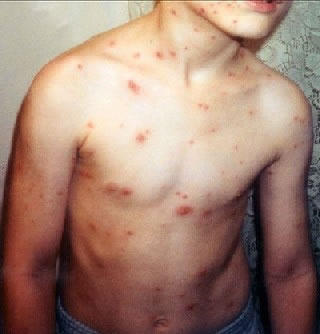
Usually starts on the belly, back, face, or scalp. Then it spreads over the whole body. Spots can also show up inside the mouth, on the eyelids, and in the private (genital) area.
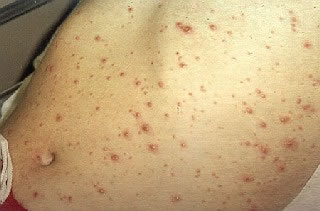
Children can get 250 to 500 spots. Children who had the vaccine usually get far fewer spots.
Each spot changes over 1 or 2 days:
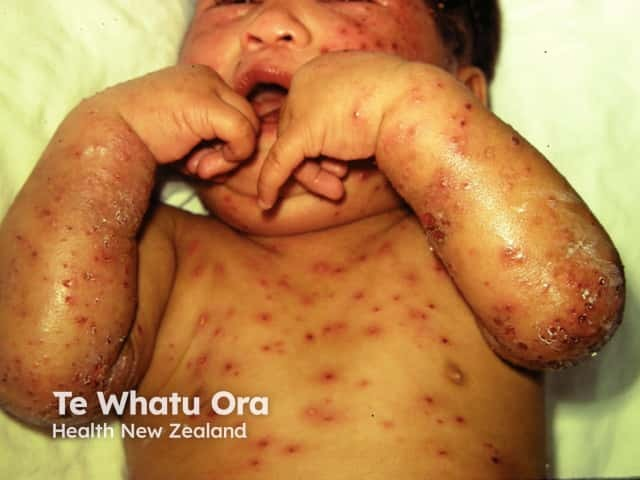
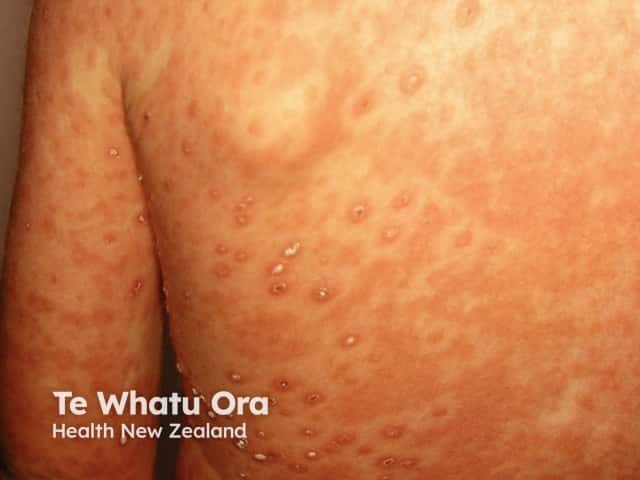
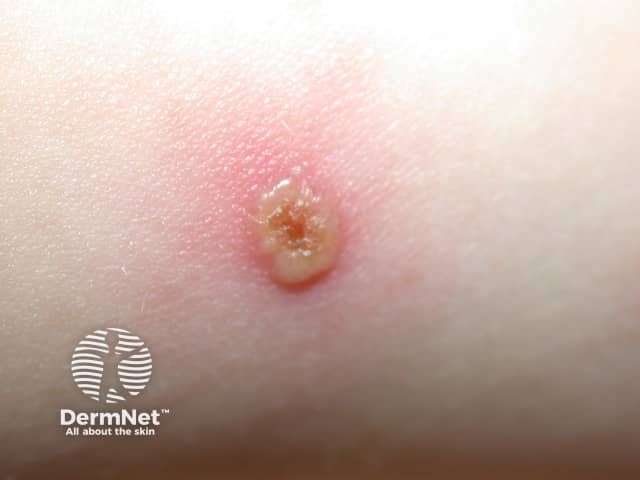
Small red bumps. They look like pimples or bug bites.
Blisters. The bumps fill with clear fluid. Then the fluid gets cloudy.
Open sores. The blisters break open.
Scabs. The sores dry into brown crusts.
New spots keep showing up for 4 to 5 days. So your child will have bumps, blisters, and scabs at the same time. This is normal.
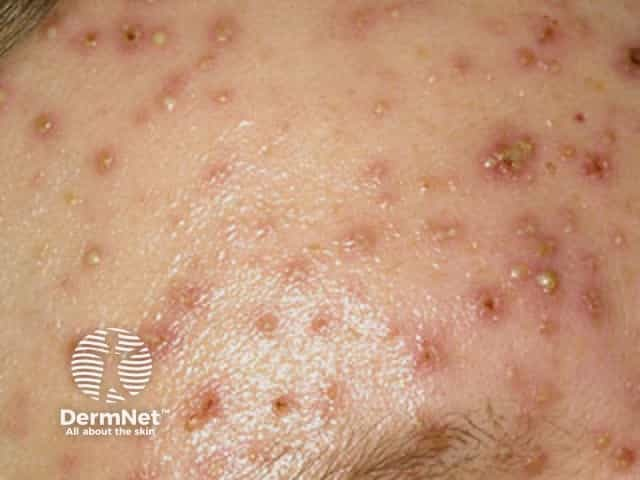
What the rash looks like
 DermNet NZ | 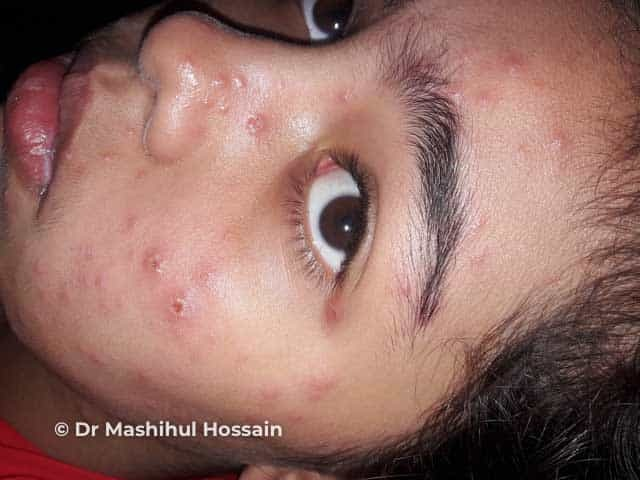 DermNet NZ |
|---|---|
 DermNet NZ | |
 DermNet NZ | |
 DermNet NZ | 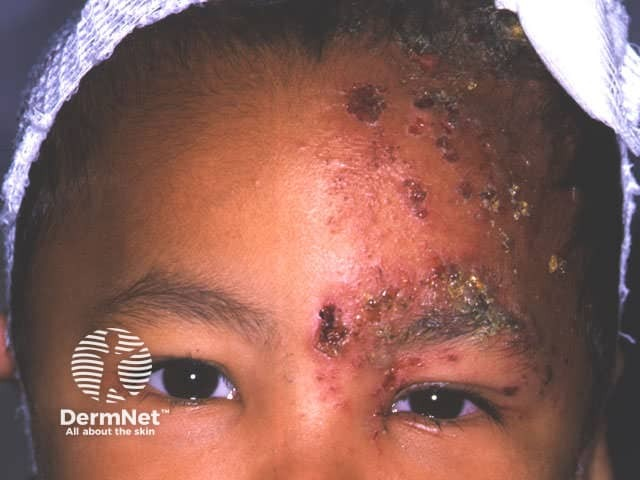 DermNet NZ Shingles Zoster |
How to treat chickenpox
Chickenpox is caused by a virus. Antibiotics do not work against viruses. But if scratched spots get infected with bacteria, your child may need an antibiotic.
Most healthy children do not need medicine for the virus itself.
Some children are more likely to get very sick. For them, the doctor may prescribe an antiviral medicine, such as acyclovir or valacyclovir. This includes children who:
Are older than 12 years.
Have a long-term skin problem, such as eczema.
Have a long-term lung problem, such as asthma.
Take aspirin every day for a health problem.
Take steroid medicines.
Antiviral medicine works best when it is started within the first day of the rash. If your child is in one of these groups, call us as soon as you see the rash.
How can I help my child feel better?
Your job is to keep your child comfortable and help stop the itching. Rest is important.
Baths for itching
Give a cool or lukewarm bath for about 10 minutes. You can do this every 3 to 4 hours, mostly in the first few days.
You can add an oatmeal bath product or 2 ounces (60 mL) of baking soda to the bath water.
Use only a small amount of mild soap to clean the skin. Strong soaps can dry the skin and make the itching worse.
After the bath, gently pat the skin dry with a soft towel. Do not rub.
Baths do not spread the rash.
Topical products for itching
Put calamine lotion on the spots that itch the most. Do not use it on the face.
You can also hold an ice cube on an itchy spot for up to 10 minutes.
Do not use creams or lotions that have diphenhydramine (Benadryl) in them. Too much of the medicine can go through the skin and cause side effects in children.
Allergy medicine by mouth for itching
If the itching is very bad or keeps your child from sleeping, an allergy medicine taken by mouth may help. Common examples are diphenhydramine (Benadryl), cetirizine (Zyrtec), loratadine (Claritin)
Ask us or your pharmacist before you give it. We can tell you if it is safe for your child's age and how much to give.
Help your child not scratch 
Scratching can cause skin infections and scars.
Keep fingernails short and clean.
Put soft gloves, mittens, or socks on your child's hands at bedtime.
Wash your child's hands often with soap and water.
Medicine for fever and pain
A fever helps the body fight the infection. It does not always need medicine.
If the fever or pain makes your child uncomfortable, you can give acetaminophen (such as Tylenol).
Never give aspirin or any medicine that has aspirin in it. Aspirin can cause a rare but very serious illness called Reye syndrome.
Do not give ibuprofen (such as Advil or Motrin) unless we tell you to. Ibuprofen may raise the risk of serious skin infections in children with chickenpox.
Mouth sores: drinking and eating
Sores in the mouth can hurt.
Drinking is more important than eating.
Offer cold drinks: things like milkshakes, popsicles, slushies,
Offer soft foods that need little chewing: things like yogurt, applesauce and other purees, ice cream and smoothies.
Avoid salty, spicy, or sour foods and drinks, such as orange juice or pretzels.
For babies, a bottle nipple may hurt the mouth. Try giving fluids with a cup, spoon, or syringe.
Liquid antacid for mouth pain (age 1 year and older)
A liquid antacid (such as Mylanta or a similar store brand) can coat the sores and ease pain. You can use it up to 4 times a day.
Age 1 to 6 years: Put a few drops in the mouth. Or put it on the sores with a cotton swab.
Older than 6 years: Use 1 teaspoon (5 mL) as a mouth rinse. Keep it on the sores as long as possible. Then your child can spit it out or swallow it.
Do not use regular mouthwash.
Sores in the private (genital) area
If sores in the private area hurt when your child urinates, you can put petroleum jelly (such as Vaseline) on the sores as needed.
What to expect
New spots will show up every day for 4 to 5 days.
The itching and fever usually get better within about a week.
Most spots heal without scars. Scars are more likely if spots get infected from scratching.
Most people get chickenpox only once. Rarely, a person can get it again.
When can my child go back to school or child care?
Your child can go back when every spot has crusted over. This is usually day 6 or 7 of the rash.
Some children who had the vaccine get only red bumps that do not crust. These children can go back when no new spots have shown up for 24 hours.
How to prevent chickenpox: the vaccine
The chickenpox vaccine is the best way to protect your child. Two doses of the vaccine protect about 9 out of 10 children from chickenpox. It protects almost all children from severe chickenpox. Children who get chickenpox after the vaccine usually have a much milder illness.
When children get the vaccine:
First dose: age 12 to 15 months
Second dose: age 4 to 6 years (before kindergarten). It can be given earlier if at least 3 months have passed since the first dose.
Ages 7 to 12 years: If your child missed one or both doses, they should get 2 doses, given 3 months apart.
Age 13 years and older: Teens who never had chickenpox or the vaccine should get 2 doses, given at least 4 weeks apart.
Children who had the chickenpox infection usually do not need the vaccine. Schools in California require a blood test to prove that your child is immune to chickenpox. If your child’s health care provider has ordered titers to document previous varicella infection, please follow the instructions on CDPH CAIR ME to request an exemption from the varicella vaccine.
Protect your family at home
Keep your sick child away from family members who have not had chickenpox or the vaccine.
Everyone should wash their hands often with soap and water.
Do not share towels, cups, forks, or spoons.
If someone in your home has never had chickenpox or the vaccine, call your doctor. Getting the vaccine within 3 to 5 days after being near the sick person can help prevent chickenpox or make it milder. Babies younger than 12 months are too young for the vaccine. Call us right away if your baby was near someone with chickenpox.
Keep your child away from others
While your child is contagious, keep them away from:
Babies, mostly those younger than 1 year.
Pregnant people. Chickenpox during pregnancy can cause serious problems for the pregnant person and the baby. If a pregnant person has been near your child, they should call their own doctor right away.
People with a weak immune system (for example, people with cancer, people who had an organ transplant, or people who take medicines that weaken the immune system).
Anyone who has never had chickenpox or the vaccine against it.
When to get help
Before you come to our office
Chickenpox spreads very easily. Some children in our waiting room could get very sick if they catch it.
Call us before you come in. Tell us your child may have chickenpox.
If you can, bring another adult. One adult can come inside first to get instructions.
For some visits, the clinician may see your child in the car or in a separate room.
If your child:
Is not moving or is too weak to stand
Has trouble breathing that is severe
Has what you think is a life-threatening emergency
If your child:
Has a stiff neck (cannot touch the chin to the chest)
Is very hard to wake up, or is confused when awake
If your child:
Has trouble breathing or a bad cough
Has a very bad headache, or bright light hurts the eyes
Is not walking steady
Has a spot or area of skin that is bright red, warm, swollen, or very painful, or has a red streak
Has a very swollen face
Has a new red rash along with the chickenpox rash
Has bleeding into the spots
Has a fever higher than 104°F (40°C)
Throws up (vomits) 3 or more times
Has eye pain or keeps blinking
Is younger than 1 month old
Has a weak immune system (for example, sickle cell disease, HIV, cancer, an organ transplant, or taking steroid pills)
Took a steroid medicine in the past 2 weeks
Has a long-term skin problem (such as eczema) or lung problem (such as asthma or cystic fibrosis)
Looks or acts very sick
If your child:
Your child is younger than 1 year old
Your child is 13 years or older and has chickenpox
Your child has never had the chickenpox vaccine and was near someone with chickenpox or shingles in the last 5 days
A fever lasts more than 4 days
A fever goes away for more than 24 hours, then comes back
A spot or scab drains yellow pus, or one sore gets much bigger than the others
One lump in the neck, armpit, or groin (a lymph node) gets bigger and more tender
Your child gets new spots after day 6 of the rash
Your child seems to be getting worse
📚 References
This content was adapted from HealthyChildren.org, The American Academy of Pediatrics Parenting Website, KidsHealth, DermNet, Vaccine Education Center at CHOP.
Images from
Reviewed by AR DO, JW MD, Patient Education Committee.