

DISCLAIMER: This material is for educational purposes only. You, the reader, assume full responsibility for how you choose to use it. It is not intended to provide medical advice, diagnosis, or treatment, nor does it replace the advice or counsel of a doctor or health care professional. Reference to a specific commercial product, service, or external web site does not imply endorsement or recommendation of that product, service, or external web site content by CPCMG. We attempt to keep lists of resources and referrals as up to date as possible; however, this information is constantly changing. Please check with the service provider and your insurance company to verify coverage.
Video: ASK UNMC! My kid has had a recurrent staph infection, what can be done?
What is a boil?
A skin infection that starts in a hair follicle or skin pore.
It is caused by bacteria called Staphylococcous aureus (commonly called “staph” for short).
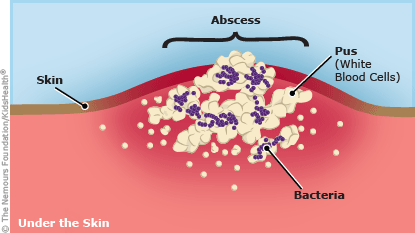
Boils form a painful, red lump in the skin that fills with pus over time.
Boils are common and not usually a serious health problem.
A boil needs to be seen by a healthcare provider for proper treatment.
What does a boil look like?
A bright red, painful lump in the skin, usually about the size of a penny or nickel.
Painful even when not being touched.
Warm to the touch.
After about a week, the center fills with pus and becomes soft — this is called "coming to a head".
A large pimple-like point may form on the surface.
|
|
|---|


What Causes Boils?
Staph bacteria live on the skin and in the nose of many healthy people. About 1 in 5 people carry these bacteria without any problems.
A boil forms when bacteria enter the skin through a tiny cut, scrape, or hair follicle.
Common risk factors include:
Friction from tight clothing (groin, armpits, buttocks, thighs, waistband)
Shaving (face, legs, armpits, or pubic area) - shaving too close can cause small cuts that let bacteria in
Scratches, bug bites, or other breaks in the skin
How Are Boils Treated?
Warm compresses:
Apply a warm, wet washcloth to the boil for 15 minutes, 3 times a day.
This helps bring the boil to a head so it can be drained.
Pain relief:
Give acetaminophen (such as Tylenol) or ibuprofen (such as Advil or Motrin) as needed for pain.
Draining - done only by a healthcare provider:
The main treatment is to open and drain the pus. This should only be done in a medical setting.
After draining, the boil will usually heal on its own.
Your healthcare provider will decide if an antibiotic is also needed.
Do NOT squeeze or try to open a boil at home.
Squeezing can push bacteria into the bloodstream or cause more boils.
Squeezing a boil on the face can be especially dangerous.
For a small red bump that has not yet become a boil:
Apply an over-the-counter antibiotic ointment 3 times a day, such as Polysporin or Neosporin.
Caring for a Draining Boil
Once a boil opens, it could drain pus for 3 to 4 days before healing.
Cover the area with a clean, dry bandage (a 4x4 inch gauze pad with tape works well).
Change the bandage twice a day.
Clean the skin around the boil with antibacterial soap each time.
Throw away used bandages in the regular trash.
Wash hands well after touching the area.
How to prevent boils?
Good hygiene is the best defense:
Everyone in the home should wash hands often with antibacterial soap or use an alcohol-based hand sanitizer.
Shower daily with antibacterial soap. Showers are better than baths because baths leave more bacteria on the skin.
Do not share towels, washcloths, or razors.
Avoid picking the nose - about 3 out of every 10 people carry Staph bacteria in their nose.
When shaving, do not shave too close to the skin.
For children who keep getting boils (recurrent boils):
Your child’s healthcare provider may recommend dilute bleach baths:
Add ½ cup (120 mL) of regular household bleach to a full bathtub of warm water.
Soak for 10 minutes, twice a week.
This is about the same strength as a swimming pool.
School, Child Care, and Sports
Closed boils (no drainage): Your child can go to school, child care, and may be able to play sports.
Open/draining boils: The drainage must be completely covered with a dry bandage at all times. If it cannot be fully covered, your child should stay home until it heals (usually about 1 week).
Children with open boils should not play contact sports until drainage has stopped.
When to call your CPCMG healthcare provider
Your child develops a fever or is acting sick.
Redness spreads beyond the boil.
The boil grows larger than 2 inches (5 cm) across.
The boil comes to a head (soft, pus-colored center) - it may be ready to drain.
Your child has pain or swelling that is getting worse.
Boils keep coming back.
You think your child needs to be seen.
📚 References
This content was adapted from HealthyChildren.org, The American Academy of Pediatrics Parenting Website, Rady Children’s Health Library, DermNet, and KidsHealth. Images from HealthyChildren.org, The American Academy of Pediatrics Parenting Website, Rady Children’s Health Library, DermNet, and and KidsHealth.
Reviewed by AR DO, JW MD, Patient Education Committee.