DISCLAIMER: This material is for educational purposes only. You, the reader, assume full responsibility for how you choose to use it. It is not intended to provide medical advice, diagnosis, or treatment, nor does it replace the advice or counsel of a doctor or health care professional. Reference to a specific commercial product, service, or external web site does not imply endorsement or recommendation of that product, service, or external web site content by CPCMG. We attempt to keep lists of resources and referrals as up to date as possible; however, this information is constantly changing. Please check with the service provider and your insurance company to verify coverage.
Please note: This video is from the American Academy of Dermatology. This condition does not always require evaluation by a dermatologist. Please start with your child's primary care provider first, and we can refer you to a dermatologist if needed.
Definition
A very itchy rash caused by the scabies mite
A mite is a tiny, invisible bug that burrows under the skin
Health Information
Symptoms
Widespread little red, bumpy rash that mainly involves the skin folds.
Intense itching is the main symptom. If it doesn’t itch, it’s not scabies.
Appearance. The small red bumps are often in short straight or wavy lines. These are the burrows/tunnels of the mite. The bump or water blister is where the mite entered the skin.
Location. Classic scabies is found in skin creases such as finger webs. Hands and wrists are the most common sites. Armpits, groin, scrotum, buttocks, navel, waist, and ankles can be involved.
The face and neck are usually spared. In infants, the rash can involve the face and scalp.
The rash usually looks the same on both sides of the body.
Cause
Scabies mite
Scabies comes from skin-to-skin contact with someone who has scabies.
After contact, a person will come down with scabies rash in 4 to 6 weeks.
Itching is the first symptom.
Can occur in anyone and does not mean poor hygiene.
Scabies mites do not carry any disease.
Prevention of Spread to Others
Scabies is very contagious and prevention is difficult.
It’s best to treat everyone who has had close contact.
Care Advice
Overview:
Scabies are easy to treat. Itching is the problem.
The itching normally lasts for 2 weeks after the scabies mites are killed.
Treatment with the anti-scabies cream does not help the itch.
The itching is an allergic reaction. The body reacts to the dead mites and eggs in the skin. It continues until all the skin containing the dead mites is shed. This usually takes 2 weeks.
Continuing to have the itch does not mean that the treatment didn’t work. It also doesn’t mean that it needs to be repeated.
Here is some care advice that should help.
Treating Close Contacts:
Scabies is easily spread to others. The symptoms don’t start for an average of 30 days.
Therefore, everyone living in the house should be treated before they develop a rash.
Close contacts only need to be treated once with the scabies cream.
Anti-Scabies Medicine (Prescription):
Scabies is treated with a prescription cream. (Currently, the most common product is Elimite).
If applied correctly, it’s almost 100% effective at curing scabies.
Apply the cream from the chin to the toes. Cover every square inch of the body. Don’t forget the navel, between the toes, under the fingernails and all the creases.
Areas that don’t seem infected still need to be covered with the cream.
Caution: Infants less than 1 year old also need the cream applied to the head. Put it on the scalp, forehead, temples, ears and neck. Avoid putting it around the eyes and mouth.
Bedtime is usually the best time to apply it.
Eight to 12 hours later give your child a bath with warm water. This will remove the cream.
One treatment is usually effective. For severe rashes, repeat the treatment 1 week later.
Approved for as young as 2 months old.
Steroid Cream for Itching:
For relief of itching, apply 1% hydrocortisone cream. No prescription is needed.
Do this 3 times per day to the most itchy spots.
Allergy Medicine for Itching:
For severe itching, an oral allergy medicine should help.
Age Over 1 Year: Give Benadryl 4 times per day. No prescription is needed.
Age Over 2 Years: Another option is to give cetirizine (Zyrtec) each morning and Benadryl at bedtime. No prescription is needed.
Cool Baths for Itching:
For flare-ups of itching, give your child a cool or lukewarm bath. Bathe for 10 minutes.
Can add baking soda 2 ounces (60 ml) per tub.
Avoid all soaps. Reason: Soaps make the itching worse.
Cut Nails for Itching:
Discourage scratching.
Cut the fingernails short. Reason: Prevents a skin infection from bacteria.
Cleaning the House:
Live scabies mites are in clothing your child has worn in the last 3 days.
Machine wash all your child’s sheets, pillowcases, underwear, pajamas, and other recently worn clothing. Use hot water. High dryer temps also kill mites.
Put items that can’t be washed (such as blankets) into plastic bags. You need to keep them in the bags for 4 days to kill the mites. Scabies cannot live off the human skin for more than 3 days.
What to Expect:
One treatment with a prescription anti-scabies cream usually helps. This usually kills all the scabies mites and eggs. Make sure you leave it on for 8–12 hours
The rash will heal up and go away in 2 weeks. There shouldn’t be any new rash after treatment.
The itching may last up to 4 weeks. Reason: It’s an allergic reaction to the dead scabies.
Return to School:
Your child can return 24 hours after one treatment with the anti-scabies cream.
Call Your Doctor If
Rash looks infected (draining pus, scabs become larger)
Itching becomes worse or lasts over 4 weeks
You think your child needs to be seen
Your child becomes worse
Author: Barton Schmitt MD, FAAP
Copyright 2000-2020 Schmitt Pediatric Guidelines LLC
Disclaimer: This health information is for educational purposes only. You the reader assume full responsibility for how you choose to use it. The information contained in this handout should not be used as a substitute for the medical care and advice of your pediatrician. Listing of any resources does not imply an endorsement.
#AAP
What is scabies?
A mite causes this common skin condition. Called the human itch mite, this eight-legged bug is so small that you cannot see it on the skin. People get scabies when the mite burrows into the top layer of skin to live and feed. When the skin reacts to the mite, an extremely itchy rash develops.
Human itch mite
This female mite, shown magnified 100 times, is full of eggs. She will burrow into human skin to lay her eggs.

This mite can travel from the infected person to another person. Most people get scabies from direct, skin-to-skin contact. Less often, people pick up mites from infested items such as bedding, clothes, and furniture. The mite can survive for about three to four days without being on a human. Worldwide, there are millions of cases of scabies each year.
Anyone can get scabies. It strikes people of all ages, races, and income levels. People who are very clean and neat can get scabies. It tends to spread easily in nursing homes and extended-care facilities. The good news is that a dermatologist can successfully diagnose and treat scabies. With today’s treatments, scabies need only cause short-term distress.
What are the signs and symptoms of scabies?
After the mite burrows into the skin, it takes time to develop signs and symptoms. If you've had scabies before, the itching usually begins within one to four days. When a person has not had scabies, the body needs time to develop a reaction to the mite. It can take two to six weeks to develop symptoms.
Scabies on a hospitalized patient
While spending time in a rehabilitation facility, this 75-year-old man developed scabies.
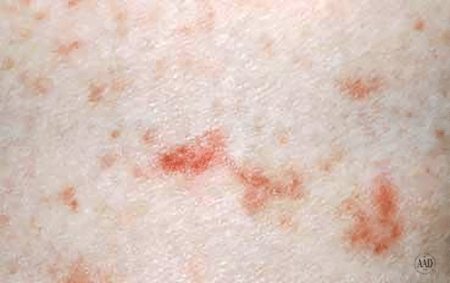
Signs and symptoms of scabies include:
The severe itch can lead to constant scratching. With non-stop scratching, an infection can develop. Non-stop scratching can even lead to sepsis, a sometimes life-threatening condition that develops when the infection enters the blood.
Scabies can develop anywhere on the skin. The mites, however, prefer to burrow in certain parts of the body. The most common places to have itching and a rash are:
In adults, the mites rarely burrow into skin above the neck.
Scabies in children
Some children develop widespread scabies. The scabies rash can cover most of the body. Even a child’s palms, soles, and scalp can be infested with mites.
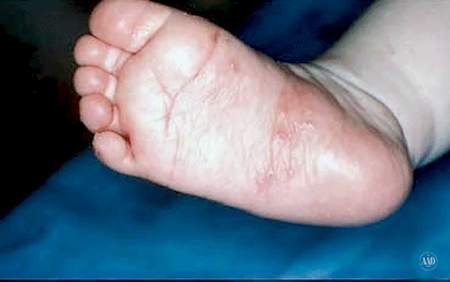
In babies, the rash often appears on the palms and soles. Babies who have scabies are very irritable and often do not want to eat or sleep. Children, too, are often very irritable. The itch can keep them awake at night.
Scabies rash on infant
Small, pus-filled bumps on the sole are often a sign of scabies in infants and young children.
Crusted scabies
Also called Norwegian scabies, crusted scabies is a severe form of scabies. People who have crusted scabies have 100s or even 1,000s of mites in their skin. By comparison, most people who get scabies have 15 to 20 mites on their skin.
Crusted scabies develops in people who have a weak immune system due to a medical condition, the elderly, and people who are living in institutions. Crusted scabies develops when the person’s body cannot develop any resistance to the mites. Without resistance, the mites quickly multiply.
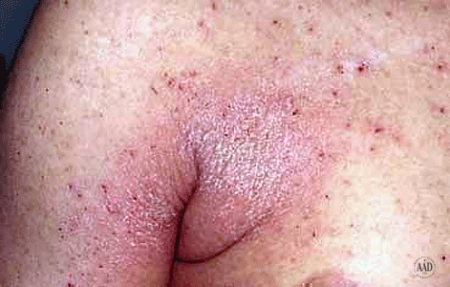
A common sign of crusted scabies is widespread crusts on the skin. These crusts tend to be thick, crumble easily when touched, and look grayish in color. Sometimes the crusts appear on one or a few areas of the body such as the scalp, back, or feet.
Crusted scabies on arm and chest
Crusts, such as the one on this man’s arm and chest, form when people get crusted scabies, also called Norwegian scabies.
Images
Who gets scabies?
Anyone can get scabies. Because skin-to-skin contact is the most common way to get scabies, the following people are especially susceptible:
Having a weakened immune system also increases the risk of getting scabies. The elderly and people who have a weak immune system due to disease such as HIV/AIDS, lymphoma, or leukemia have an increased risk. People who received an organ transplant also have a higher risk.
Crusted scabies is especially contagious. A crust filled with mites can fall off. This shed crust can provide food and protection for the mites, allowing them to live for as long as one week without human contact.
Scabies among people in nursing homes and extended-care facilities has become a common problem in the United States. The residents often need help with daily tasks, so there is frequent skin-to-skin contact. Scabies can spread to nursing staff. The staff can then spread scabies to other residents. This can happen quickly.
Scabies can spread when people do not have any signs or symptoms. A person who has never had scabies often does not have any signs or symptoms for two to six weeks.
What causes scabies?
The human itch mite causes scabies. People get scabies when the mite burrows into the skin. You can get the mite on your skin through:
You cannot get scabies from an animal that has mites. Only humans get this type of scabies.
Most people will not get scabies from a handshake or hug. The skin-to-skin contact must be longer for a mite to crawl from one person to another. Adults often get scabies through sexual contact.
How do dermatologists diagnose scabies?
A dermatologist can often diagnose scabies by visually examining a patient’s skin from head to toe.
To make sure that a patient has scabies, a dermatologist may remove some skin. This is painless. Your dermatologist will put the skin on a glass slide and look at the slide under a microscope. If your dermatologist sees scabies mites or their eggs, it is certain that you have scabies.
How do dermatologists treat scabies?
To get rid of scabies, treatment is essential. Medicine that treats scabies is only available with a doctor’s prescription.
Who needs treatment?
The person diagnosed with scabies and everyone who has had close contact with that person need treatment. Even people who do not have any signs or symptoms must be treated. This is the only way to prevent new outbreaks of scabies weeks later. People who should be treated include:
Most people can be cured with a medicine that they apply to their skin. These medicines are often applied to all skin from the neck down. Infants and young children often need treatment for their scalp and face, too. A dermatologist will provide specific instructions to follow.
Most medicine is applied at bedtime. The medicine is then washed off when the patient wakes up. You may need to repeat this process one week later.
It is important to follow your dermatologist’s instructions. Treating the skin more often than instructed can worsen the rash and itching.
Medicines that may be prescribed include:
Treatment for widespread scabies
Scabies that covers much of the body and crusted scabies often require stronger medicine. A patient with this type of scabies may receive a prescription for ivermectin. This medicine can be prescribed to children and patients who are HIV-positive. Some patients need only to take one dose, but many need to take two or three doses to cure scabies. The pills are usually taken once every two weeks.
When scabies infects many people at a nursing home, extended-care facility, and other institution, ivermectin may be prescribed to everyone who has a risk of catching scabies.
Other signs and symptoms
Some patients need other treatment, too. Your dermatologist may prescribe:
Outcome
Treatment can get rid of the mites, eliminate symptoms such as itch, and treat an infection that has developed. For the first few days to a week, the rash and itch can worsen during treatment. Within four weeks, your skin should heal.
If your skin has not healed within 4 weeks, you may still have mites. Some people need to treat two or three times to get rid of the mites. Be sure to see your dermatologist for treatment. You should never use a scabicide used to treat crops or livestock.
People who develop crusted scabies, also known as Norwegian scabies, often need repeat treatments to get rid of the mites.
To get rid of the mites and prevent getting scabies again, you have to do more than treat the skin or take a pill. You will need to wash clothes, bedding, and towels to get rid of mites that may have fallen off your skin. You also should vacuum your entire home.
The mite that causes scabies is hardy. These tips can help you get rid of the mites.